
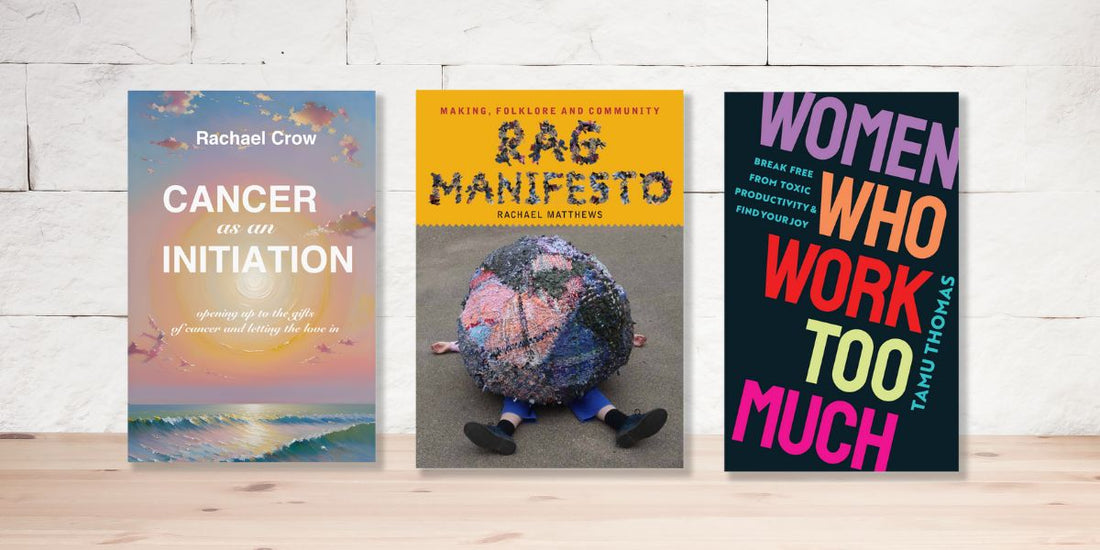
 Cancer as an Initiation: Opening Up to the Gifts of Cancer and Letting the Love In
By Rachael Crow
In Cancer as an Initiation, Rachael Crow describes how her cancer diagnosis became an opportunity to make real change in her life, to bring elements of home, work, health, emotions and relationships into balance. Her illness initiated deep soul searching and the chance to emerge anew.
When I spoke to Crow for My Life My Way (page 80), she mentioned I was one of the few people without cancer who had read her book. What I thought when reading it, however, was how useful it was to read it in those circumstances. It made me rethink what the experience of illness could be. I have always feared getting a serious illness, particularly since having children (Crow acknowledges in the book that the most difficult thing to come to terms with was the prospect of leaving her children), but she shows us ways to live with illness without allowing it to consume you. She has an astonishing attitude, and it is an enlightening perspective to consider.
Doulas often discuss the importance of advocating for oneself within the birthing sphere, and Crow adopts the same stance in this book towards the medics who delivered her treatment. Rather than falling into the role of “helpless victim”, subject to decisions made about her rather than by her, this approach empowered her and gave her agency.
Crow writes about the importance of community in her healing, and it’s very clear in the book that “the women” were a tangible support system for her. Ritual is also powerful, helping her to mark and move through poignant life moments. For decades, cycles and the womb were central to Crow’s life and work, and it was deeply moving to read about how she honoured her last bleed.
Crow is generous in her openness throughout this book. Frank in her assessment that she did not know whether she was going to live or die, she finds herself making an active choice that she wants to live. That really stuck with me. Well or unwell, it’s a powerful decision to make. So often we take life for granted. Cancer as an Initiation made me remember to choose to live and to choose how to live.
 Rag Manifesto: Making, Folklore and Community
By Rachael Matthews, Quickthorn
Rag Manifesto asks us to look up from the age we live in – of abundance and affluence – and to see the value of the rags we discard. “Rag is not waste,” Rachael Matthews writes. “It is a precious material made from the earth’s resources and it is imbued with meaning and potential.”
Matthews’ love of rag work started in lockdown when she began noticing piles of clothes being thrown out by people who suddenly had time to sort through the volumes of unwanted garments they had amassed. She diligently collected them all up, put them through the washing machine and turned them into rag, ready for her next project.
She’s a prolific creator – there’s piece after piece of glorious art made from what would otherwise have been landfill. My favourite work, ‘Lose Your Rag’, is one she made after clearing out the house of her parents-in-law, who never got rid of anything. She makes the most beautiful firework piece from her father-in-law’s thermal underwear, dyed indigo, and her mother-inlaw’s beautiful, little-worn lace knickers.
Matthews' practice is an act of environmentalism and at the same time full of humour and artistry. I love the pictures of her in her local park, a backstrap loom fashioned on a public cycling machine, a tent peg loom hammered into the grass. It’s also a generous practice. She runs Rag School at East London Textile Arts (ELTA), where she facilitates participatory community projects, often making big collaborative pieces that take on a performative element. In one of her projects, waste fabric from the River Roding was transformed into ‘Rag River Rugs’. The group journeyed the finished pieces on a riverboat up the Thames from the north of Greenwich to the Tower of London “to make a presentation to professional weavers at The Experimental Weave Lab at the Clothworker’s Company”. What a glorious new life for this ‘waste’ fabric. The book is full of gems like this. Matthews’ message is clear: consider rag differently and we will begin to consider the world differently.
 Women Who Work Too Much: Break Free from Toxic Productivity and Find Your Joy
By Tamu Thomas, Hay House
This is a powerful book that asks us to question societal norms that glorify relentless productivity and lead to women feeling overwhelmed, burned out and disconnected from their true selves. It’s not that work is ‘bad’ – indeed, Thomas describes how it can be a nourishing part of life – it’s just that it has fallen out of balance with other aspects of our lives. She dissects systems that have contributed to us understanding our worth by how hard we work: the “oppressive trinity of white supremacy, patriarchy and capitalism”. She explores how “covert rules have passed down a system of oppression from one generation to the next, and whose effects are exacerbated for women of colour, at the intersection of misogyny and racism”.
Once we realise how we’ve got to this place of toxic productivity, Thomas asks us to step back from ‘what we do’ to discover ‘who we are’. She encourages us to value rest and relaxation and to see these as markers of our success. Surely what we are all striving for in working so hard is a better life, not one that squashes our life force. It’s easy to feel shame for resting when there are always a million ‘useful’ things we could be doing, but I love the way she suggests that rest might become “an act of rebellion against a culture that inflicts perpetual busyness”. She writes, “In honouring our need for rest, we signal to our ancestors that their struggles were not in vain. We create a legacy of joyful resilience rooted in self-compassion, authenticity and healthy boundaries.”
I was worried, as a person working part-time hours, that I wouldn’t identify with the women Thomas speaks to in this book, but that’s the kind of thinking Thomas addresses. All the unpaid ‘work’ women often do, “the second shift” of looking after children and running a house, goes unrecognised and unvalued. Women Who Work Too Much is a wise, soulful exploration of self-care, connection and social justice. It helps us re-evaluate the way we view life and work, with journal prompts and exercises in each chapter to support self-reflection.
____
 Reviews by Alice Ellerby
Published in issue 89. Accurate at the time this issue went to print.


